
Frame by Frame
Deepening authentic practice in ACT through Contextual Functional Analysis
A 3 day Clinical Intensive
Experience ACT and RFT in practice, with Dr. Siri Ming, Dr. Evelyn Gould, & Dr. Julia Fiebig
Toronto, Canada: October 19 - 21
Hosted by Shining Through Centre and co-sponsored by Applied Behavioural Interventions
Whether you’ve run into roadblocks on your ACT journey, are just starting out or have hit a plateau, join us in Toronto this fall to explore a roadmap for practicing flexibly and fluently—a coherent, conceptually systematic framework for conceptualizing cases and developing contextually sensitive, responsive interventions that go beyond hexaflex-based curricula, protocols or exercises.
This is ACT, rooted in Contextual Functional Analysis.
23 CEs; 4 Ethics | 3 supervision | 1 EDI
Includes 3 month free membership to the Constellations Practitioner Lab & Community of Practice!
About the Workshop
Our approach to ACT is grounded not only in behavior analytic principles and RFT, but in a view of our work as promoting wellbeing, resilience, and thriving—a view that places psychological flexibility as the aim of all that we do. We define ACT as just that—the promotion of psychological flexibility within cooperative contexts for change, based on a contextual functional analysis: an analysis that considers influences at every level from the self to the groups, systems and cultures that shape our practice.
Over the last decade we have been developing and building on the case conceptualization framework published in our book, Understanding and Applying Relational Frame Theory, creating the tools we wish had been available as we began to integrate ACT and RFT into our practices. And we developed Frame by Frame as the workshop we wish had been available to us then as well.
What we’ll be doing together:
In Frame by Frame, you'll explore what it means to practice ACT as a behavior analyst and learn to apply Contextual Functional Analysis across the populations and contexts relevant to your practice — early intervention, school-aged children, adolescent and adult populations, parent collaboration, staff training, supervision, professional development. We’ll work through cases together over three full days, giving you a depth of practice and connection that is hard to achieve online.
We’ll also have conversations about the purpose of our work as contextual scientists, regardless of practice area or population: promoting psychological flexibility, prosociality, the sustainable use of resources, diversity, equity, and inclusion, at all levels of interaction. And, we’ll talk about how resourcing ourselves and improving our own psychological flexibility is often the most important starting point for our work with others.
The basics:
Where: Mississauga, ON, Canada
When: October 19-21, 2026
Cost: CA$750 Regular Registration
CA$637.50 Group Registration
23 CEs; 4 Ethics | 3 Supervision | 1 EDI
Constellations Practitioner Lab
trial membership included
Our framework:
The framework we’ll offer during this workshop rests on all three key elements of our definition of ACT: a focus on psychological flexibility, cooperation, and contextual functional analysis. You will consider relevant component repertoires that support psychological flexibility and cooperation— from early foundations emerging from infancy, through complex language—and the functional relations that influence these repertoires at all levels (self, individual, groups, systems and culture). And, you will consider the importance of establishing nurturing environments and relationships that support psychological safety, learning, and healthy development. The “ACT stance” plays a critical role in this process, regardless of role or client population: that is, it supports the creation of cooperative contexts for behavior change.
We’ll be fostering the same kind of context for growth with you in Toronto—a nurturing space to learn together, practice authentically, and collaborate in real time with peers who value a strengths-based, compassionate approach. A space in which "the learning is not separated from the learner, the knowledge from the knower, the practice from the practitioner."
What you'll come away with:
A case conceptualization framework that supports the integration of ACT and RFT across populations, contexts, and professional roles — without limiting practitioners to a specific assessment tool or curriculum. You'll explore a new way of approaching cases during the workshop, and you'll leave with a way of thinking about your work that brings together what you already know into a coherent analytical process.
You'll also leave with a concrete plan for what's next: what you'll do in the next days, weeks, and months to continue developing your skills, as well as connections to other practitioners sharing the journey. To support you in this journey, we are offering all participants a free 3 month membership to the Constellations Practitioner Lab and Community of Practice, including free monthly CEs!
Scope of competence & practice:
We address scope of competence and practice directly throughout the workshop, as well as during an optional evening session. You will be invited to apply what you are learning during the workshop to your specific role, the kinds of services you provide, and the client populations you serve.
Who this workshop is for:
Practitioners: RBAs/BCBAs, mental health providers or other professionals with a behavior analytic background, and some existing familiarity with ACT, that want to deepen their understanding of how ACT, RFT, and behavior analytic practice connect — as a unified approach to promoting psychological flexibility within cooperative contexts for change. Whether you're working in early intervention, school consultation, organizational behavior management, supervision, or clinical practice, the framework applies.
You don't need to leave behind what you've already learned in order to be here. Contextual Functional Analysis builds on what you know. If you've learned ACT through the hexaflex, we'll help you see how that connects to a functional, contextually grounded analysis and case conceptualization. If you already have a strong foundation in RFT, we'll help you put that understanding to work in case reasoning. And if you’re only just beginning in ACT or can barely remember what RFT stands for, we’ll help you get started in a conceptually systematic way! You already understand how functional analysis works in an ABA practice—we’ll help you broaden and extend that logic to capture the full context influencing behavior. There's real consilience across these traditions, and drawing that out is part of what we're here to do.
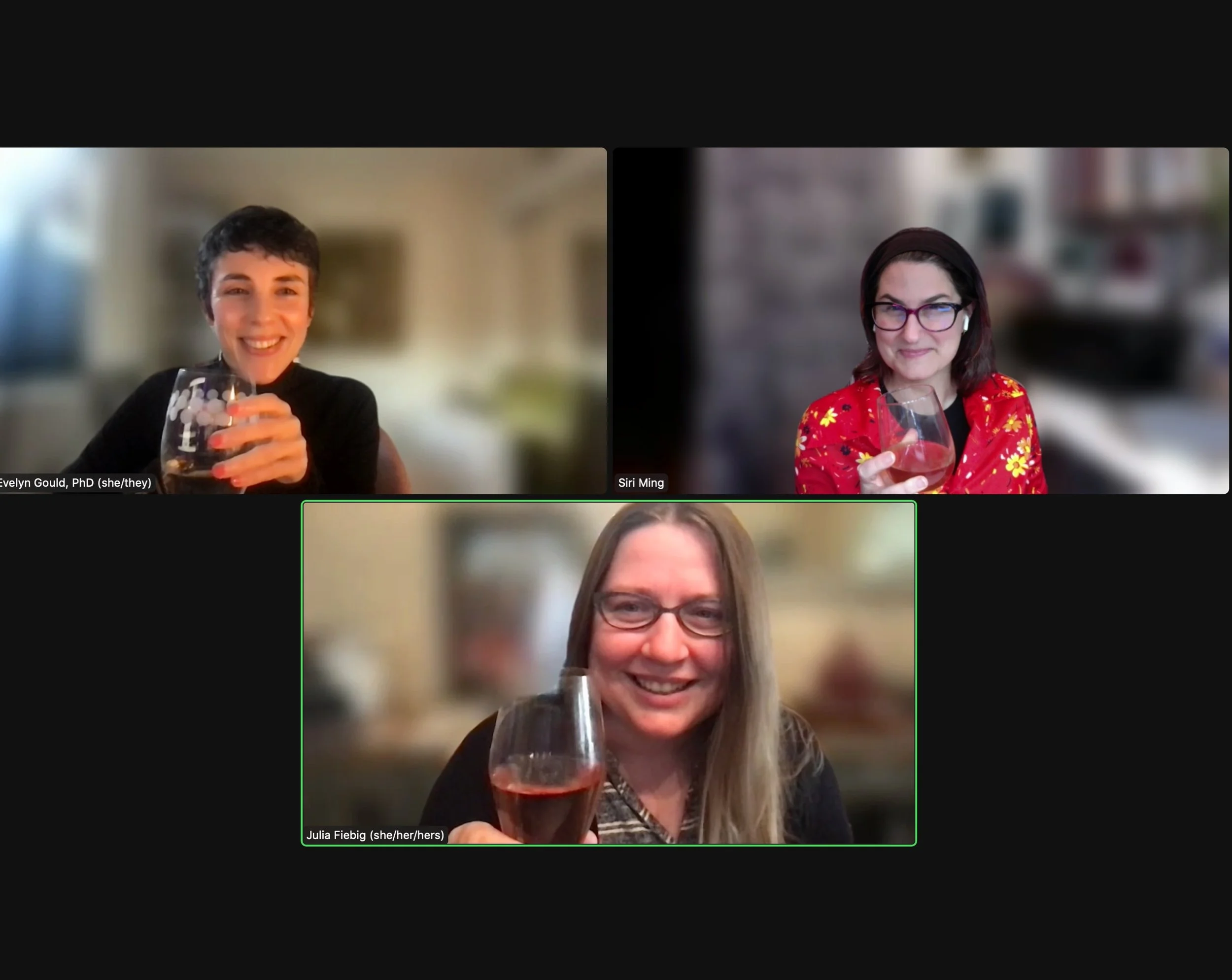
Meet Siri, Evelyn, & Julia
-
Our work together
Dr. Siri Ming, Dr. Evelyn Gould, and Dr. Julia Fiebig are the co-authors of Understanding and Applying Relational Frame Theory (New Harbinger, 2023). We each have over 25 years of experience in behavior analysis, clinical psychology, ACT, RFT, prosocial practice, organizational systems, and school consultation. Our work reflects a commitment to collaborative, nonhierarchical practice — acknowledging expertise while also recognizing that none of us has the whole picture, and that the best work happens when we're willing to embrace that.
We arrived at our shared work with different educational backgrounds and work and life experiences, giving us different perspectives on language as behavior and how to analyze it. Our histories brought us together, and also helped us recognize how our work mutually complements each other. We approach our projects as a journey of integrating all of our perspectives in service of shared values with respect for the dissemination of behavior science, contributing to the health of the field, and working toward social and environmental justice. In line with those values, we co-founded Constellations, this training platform and community of practice for behavior analysts and contextual behavioral scientists, where we facilitate a practitioner lab, develop and support on-demand courses, and run book clubs and coaching groups.
-

Siri Ming, Ph.D., BCBA-D (she/her)
Siri is a behavior analyst, educator, and peer-reviewed ACT trainer, originally from western Canada and currently residing in Baltimore, MD. Her work centers on what changes when practitioners take the science of language seriously — integrating RFT and ACT into behavior analytic practice as connected expressions of the same science.
Siri is a trusted guide for behavior analysts seeking to bring clarity, purpose, and compassion to their practice. She is co-author of Understanding and Applying Relational Frame Theory, Using RFT to Promote Generative Language, and Finding Your Why and Finding Your Way, as well as numerous peer-reviewed publications on derived relational responding, early language intervention, ACT, and verbal behavior. With over 30 years of experience as a scientist-practitioner, she specializes in making RFT accessible for working behavior analysts, with a focus on practical applications across contexts — from early language intervention to building cooperative, prosocial practice environments. In addition to her private practice and her work through Constellations, she teaches at the graduate level for Ball State University. Her work is grounded in values of rigor, generosity, and kindness, and the importance of connecting with joy and with community. Read more about Siri and her work: www.siriming.com
-

Evelyn Gould, Ph.D., BCBA-D, C.Psychol (they/she)
Evelyn (Evie) is a licensed clinical psychologist, clinical behavior analyst and Fellow of the Association of Contextual Behavioral Science. Evie is a scientist-practitioner working to empower others to build rich and meaningful lives through evidence-based, values-driven, affirmative, and culturally responsive practices. They specialize in OCD and related disorders, anxiety, ADHD and autism, LGBTQIA+ mental health, and working with caregivers. Evelyn is also committed to lifelong learning and values-driven research, training, and mentorship. They have published peer-reviewed articles and book chapters on gender, neurodivergence, supporting caregivers, student mental health, compassionate care, acceptance and commitment therapy (ACT), and behavior analysis. Evelyn serves on a variety of community advisory boards, task forces, and other groups within their professional communities and was previously an associate editor for the Journal of Contextual Behavioral Science. Their work reflects personal and professional values of compassion, authenticity, social justice, and cultural humility. Evie is from Belfast, Northern Ireland—currently residing in Los Angeles, CA with their spouse and three cats. They identify as Neuroqueer. Read more about Evie and their work: www.evelyngouldphd.com
-

Julia Fiebig, Ph.D., BCBA-D (she/her)
Julia is associate teaching professor at Ball State University in the applied behavior analysis (ABA) program. She is from Germany, and lives in the San Francisco Bay Area. Her primary focus is on applications of behavior science to organizational leadership, sustainability, and regenerative systems design—collaborating with leaders and organizations to cultivate values-informed, consensus-building, prosocial practices. As a practicing behavior analyst for over twenty-five years, Julia has a range of experience consulting and working internationally with clinical, educational, and other nonprofit and private organizations. As an educator, Julia is passionate about teaching young people values of inclusive and responsible community building across diverse cultural backgrounds. She has served on the climate change task force for the Association for Behavior Analysis International (ABAI) and the Association for Contextual Behavioral Science, and currently serves on the board of special interest groups (SIGs) and ABAI’s Practice Board. Julia is dedicated to working on issues of environmental justice and contributing to wider application and dissemination of a compassionate behavior science, and she also finds joy in her craft as a musician and writer/composer.
Outline & Learning Objectives
Day One: ACT and RFT Foundations
We begin by setting the foundation for our work together, establishing a common language for discussing ACT as the promotion of psychological flexibility within cooperative contexts for change, grounded in contextual functional analysis. We’ll define terms behaviorally, establish psychological flexibility as the aim of ACT and as central to socially valid practice, and ensure everyone has a grounding in the theoretical foundations of ACT in terms of relating as an operant. And, we’ll help you connect the dots in terms of ACT models like the hexaflex and DNA-V, and how they can be viewed from a fully functional perspective.
We’ll also introduce our Contextual Functional Analysis framework. You’ll start to conceptualize cases from this perspective, determining what psychological flexibility would look like for a client (and/or for yourself) and developing overarching, socially valid goals focusing on measurable behavior change.
Experiential Objectives:
Describe and conceptualize psychological flexibility repertoires within the context of interlocking contingencies (parent child over time, practitioner-client, supervisor-supervisee, etc.) (Supervision)
Describe how psychological flexibility and generative behavior is related to enriching environments, expanding repertoires, expanding sources of reinforcement, and increasing choice-making opportunities and skills. (Ethics)
Identify at least one way that psychological flexibility (or inflexibility) impacts you personally as a behavior analyst, and identify strategies for increasing your own psychological flexibility
Identify the ways in which your own practice supports or hinders flexibility (in yourself and others), and how the ACT Stance can support psychological flexibility (Supervision)
When conducting a Contextual Functional Analysis, consider the need to concurrently examine the influence of variables in the context of your self and your own learning history
When conducting a Contextual Functional Analysis, consider social, cultural, medical and biological factors, the larger picture of the client’s context in terms of interlocking contingencies with others, and the appetitive and aversive functional relations and clear skill deficits influencing behavior and creating barriers to psychological flexibility.
Develop goals related to psychological flexibility that focus on measurable objective behavior change.
Technical/Educational objectives:
Define psychological flexibility, cooperation and prosociality from a behavior analytic perspective as complex language repertoires.
Describe ACT as the promotion of psychological flexibility within cooperative contexts for change, grounded in contextual functional analysis.
Describe relational responding as an operant, with multiple dimensions and levels of developmental complexity, functioning within a motivational context.
Describe how transformation of function is relevant to promoting psychological flexibility
Describe how a functional definition of ACT in terms of psychological flexibility as a complex language repertoire maps onto common ACT models.
Describe how ACT provides a socially valid framework for behavior analytic practice (Ethics)
Optional Evening: Scope of Competence & Practice
A panel discussion centered on determining scope of practice, and expanding scope of competence.
Objectives:
Discuss how scope of practice is defined in terms of your licensure in your region. (Ethics)
Describe your own scope of practice and scope of competence, along with critical questions to reflect on as you consider expanding your scope. (Ethics)
Day Two: Repertoires of Psychological Flexibility
Day two unpacks the many component repertoires that are involved in psychological flexibility, and cooperation with a developmental focus that allows ACT to be applied across the age span, based on meeting every client where they are at in terms of existing skills. We’ll begin with describing foundations for psychological flexibility that are established in early childhood, moving on to foundations for healthy selfing as well as the complex selfing repertoires involved in psychological flexibility as a language repertoire. We’ll be defining and describing how rule-governed behavior is involved in both psychological flexibility and inflexibility, and exploring foundations for valuing as well as valuing as rule-governed behavior. At every point, we’ll be discussing the importance of nurturing environments and prosocial interactions to the development of psychological flexibility.
Throughout the day you’ll be building a case conceptualization through Contextual Functional Analysis that identifies the the influence of relevant appetitive and aversive functional relations as well as skills across repertoires of psychological flexibility. You’ll start to identify goals and practical strategies for promoting foundations for psychological flexibility; promoting repertoires of healthy self-ing; and promoting valuing and contextually-sensitive rule following— for clients, caregivers, and ourselves. **
Experiential Objectives:
Explore your own conceptualization of yourself, including the relational patterns you can identify between your self and different aspects of your context.
Explore the power of values to transform stimulus functions, with respect to your own values and activities.
Identify your own and others’ behaviors that demonstrate cooperation—including curiosity, empathy, compassion, and humility—when observing interactions.
Identify how your own selfing repertoire contributes to establishing an effective working alliance, and relates to your identity as a group member for a variety of groups that you belong to.
When conducting a Contextual Functional Analysis, consider aversive and appetitive contingencies as well as skills in terms of foundational repertoires for psychological flexibility (including self-ing, hierarchical relating, valuing and rule-governance), and how these support or create barriers to psychological flexibility for clients, caregivers, and yourself.
Technical/Educational Objectives:
Define component repertoires and operant dimensions of psychological flexibility including
observing and stimulus orienting
behavioral variability
perspective taking (including empathy, compassion)
selfing
hierarchical framing
curiosity and
valuing
Define rule-governed behavior in terms of relational framing, including transformation of function as it pertains to rule-governed behavior.
Describe the relationship between rule-governed behavior and psychological flexibility.
Day Three: Scaling Up and Zooming Out
Our final day focuses on how interlocking contingencies at all levels support and hinder psychological flexibility and cooperation. We return to more deeply consider the ACT Stance, prosocial principles, and the relevant speaking and listening repertoires that are necessary to establish task agreement and a working alliance with clients and to establish prosocial practices within groups. We’ll also extend the discussion to how systems and cultures exert influence over behavior, supporting or hindering psychological flexibility and cooperation. And, we’ll consider the importance of sustainability in all that we do—supporting sustainable practices for ourselves, as well as for clients, caregivers, and staff.
You’ll complete your case conceptualization through Contextual Functional Analysis with a consideration of these larger levels of influence, including how individuals also influence groups and systems, and how you can plan for prosocial change.
We will wrap up the workshop with time to reflect and plan for what’s next—how will you support your own psychological flexibility? How will you take what you’ve learned and integrate it into your practice? How will you ensure the sustainability of your effort as you make changes? You’ll leave with a plan of action to take you forward into the next week, next month, and the long-term that takes into account all the levels of contextual influence on your own behavior.
Experiential Objectives:
When conducting a Contextual Functional Analysis, consider aversive and appetitive contingencies as well as skill deficits influencing foundational repertoires for cooperation, for clients, caregivers, and yourself.
When conducting a Contextual Functional Analysis, consider the need to concurrently examine the influence of variables in the context of the self and one’s own learning history extended to interlocking contingencies between individuals, groups, organizations, systems and the larger cultures within which we all operate.
Describe how repertoires of psychological flexibility, cooperation, and prosociality influence systems and organizing agencies and are critical to the design of a more prosocial world.
Identify how the different systems and professional cultures that individuals operate in influence their work together toward a common outcome in ways that may foster or inhibit cooperation and prosociality, and identify an action that you can take to help shift from aversive to appetitive control. (Supervision)
Explore what sustainability means to you at individual, group, community, or global systems levels, clarifying your perspective with respect to yourself and your social identity and how your values influence your own speaker behavior with respect to sustainability.
Identify ways in which you can begin to incorporate a broad focus on promoting psychological flexibility within a cooperative context for change in your practice.
Technical/Educational objectives:
Describe listening from a behavior analytic perspective as part of interlocking speaker-listener contingencies, including attending and responding to contextual features of speaker behavior as well as the words that are used.
Describe the role of perspective-taking and psychological flexibility in the development of an effective listening repertoire.
Describe how speaker behavior involving derived stimulus functions, context-sensitive rules, and values influences the establishment of an effective working alliance.
Describe how the content of one’s communication, including the use of metaphor and rules, can influence listener behavior through evoking derivations and transformation of function, either promoting or hindering the development of psychological flexibility.
Explain how language processes create and maintain systems of oppression and privilege and how they influence willingness to engage in behaviors that promote diversity, equity, and inclusion.
Describe how repertoires of cooperation and psychological flexibility are necessary to effective individual and collective action toward issues of diversity, equity, and inclusion.